Chamber Music Society of Lincoln Center Spring Gala honors master luthier Samuel Zygmuntowicz


This year's annual Chamber Music Society Spring Gala at Alice Tully Hall honors American master luthier Samuel Zygmuntowicz. The concert on May 19th reflects on the historical roots of classical music-making and what makes the art form thrive. It features some of CMS's eminent string players performing on instruments crafted by Zygmuntowicz over a forty-year span for CMS performances.
Violinists Chad Hoopes, Bella Hristova, Richard Lin, and James Thompson; violist Matthew Lipman; and cellist and CMS co-artistic director David Finckel will perform works by Telemann, Mozart, Dvořák, Moszkowski, Rachmaninoff, and Frolov. They will collaborate with pianists Orion Weiss and CMS co-artistic director Wu Han.
Finckel, who plays a "Zygmuntowicz" and recently commissioned another instrument from Sam — as he is colloquially known within the close-knit industry — has commented enthusiastically: "From the birth of the violin in the hands of the Amati family in the mid-1500s, the instrument evolved steadily, culminating in the golden period of Antonio Stradivari in the early 18th century. It is astonishing to realize that we have entered a second golden period of violin making, led by one maker: Samuel Zygmuntowicz."
Intrigued by the man behind such a stellar reputation, I seized the opportunity to interview Zygmuntowicz in his Brooklyn Park Slope townhouse/workshop.

Photo Credit: Ilona Oltuski
The profession of a luthier—a craftsman dedicated to making stringed instruments—is certainly a blend of artistry and technical skill. "I've been a sculptor since I was very young," Sam ventures, pointing to a mask that adorns a wall in his living room.

"I was always sitting somewhere and making something. Then I realized that no one needed a second Rodin. That's who I wanted to become, a master like the famed sculptor. But then I read a book about a violin maker," he remembers.
"Working alone always had suited me, and that perfectly combined different sensitivities and capabilities I had – an artistic object, crafted by a sculptor, but performed by other artists," he describes the art of violin making. "When I am carving wood, I am like a carpenter or a sculptor. When I am varnishing, I am a painter, an artist. Once it goes into the performer's hands, I become like a doctor, or sometimes a psychiatrist," he smiles and adds, "and then it becomes all about their experience with the instrument."
Photo Credit: Ilona Oltuski
As the son of Jewish Polish immigrants with trauma of persecution and escape, the violin also fit perfectly into his heightened sense of the possible need to be on the move at all times. He says what also attracted him to the violin was its tradition. "There is this rich body of accumulated wisdom that is in danger of being lost. It's worth extracting and creating something living from it," he explains.
Despite his deep appreciation for the tradition of the craft, Sam has a more realistic view of the day-to-day: "Many of my colleagues consider the profession a romantic craft, but I don't really see it that way," he says. "It's meant to be played by musicians, so you have to talk to musicians. I tend to work with great professionals, and what they want is hard to achieve but not that hard to understand," he says.
Since establishing his Brooklyn workshop in 1985, he has created commissioned instruments for many of the world's foremost performers, including Isaac Stern, Joshua Bell, Maxim Vengerov, Cho-Liang Lin, Leila Josefowicz, and members of the Emerson and Orion string quartets.
Perhaps his biggest breakthrough moment was when he met his idol, Isaac Stern, whom he describes as a "culture hero."
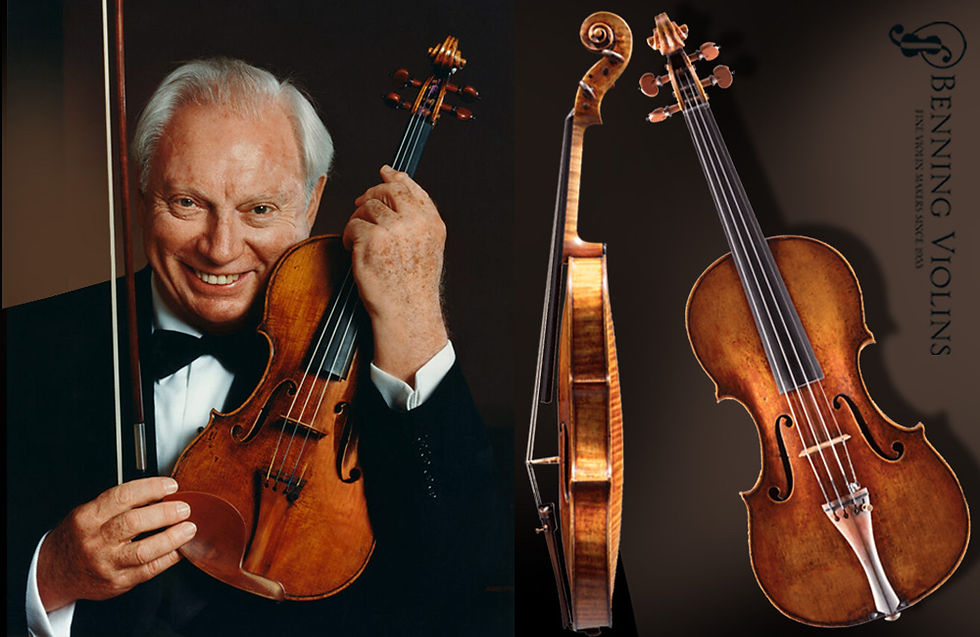
"Meeting him was like being in the realm of history being made," he adds. Sam talks about how he made two reproductions of Stern's famous Guarneri del Gesu instruments, including the ex-Ysaÿe Guarnerius, for the violinist he admired so much. The record sale of these instruments at auction in 2003, two years after Stern's death, also brought Sam widespread recognition.
"What is a great instrument supposed to do?" He continues, answering his own question: "It is played in large halls without amplification, so it has to be loud enough to project and be heard at a distance, but also soft enough up close. In addition to the importance of dynamic range, the played notes must start cleanly, to be heard without the wolf tone, which I learned is an unwanted, disturbing warbling sound that occurs when a played note closely matches a natural resonance of the instrument's body."
"If one does not hear a clear sound, no one can hear the quality," he adds.
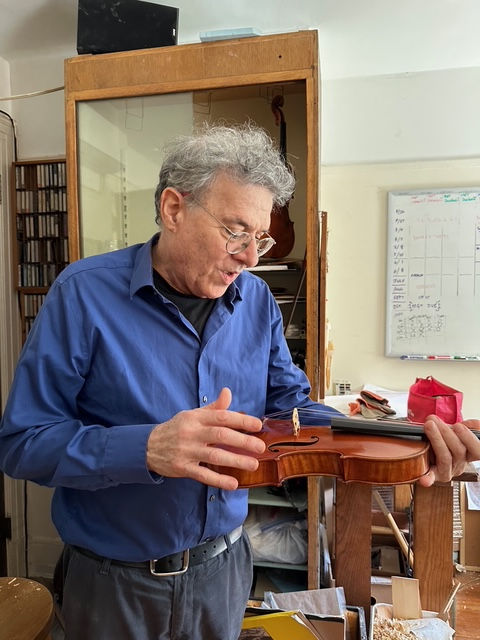
Sam had started out self-taught and too young for formal apprenticeships. While polishing violins, he worked in important workshops and learned from the field's leading masters, including the renowned Carl Becker and René Morel.
He describes how working with the great makers' instruments has allowed him to understand what has already been achieved and how it was done. It all became about research and hands-on experimentation with different shapes and sizes. He asks himself, "What would happen if one used a slightly smaller part here or a slightly higher arch there?" He also considers how these issues were solved in previous periods. Like music itself, it is also a lot about the relationship of the parts and how they fit together. Every piece of wood is different. Ultimately is up to me to understand how all these things relate to each other," he explains.

When asked about his interactions with his fascinating clientele, he says, "I work closely with my clients and see almost all of my instruments periodically." The first cello I made for David was in '92. He has a creative and inquisitive mind, so I was able to do a lot of work on his instrument and make various adjustments. At the time, we visited Rostropovich, who was David's great mentor and owned the famous Duport Stradivarius, a cello made by Antonio Stradivari of Cremona in 1711."
Named after Jean-Louis Duport, it is one of Stradivari's "B-Form" cellos, which were first used in 1709 and are slightly smaller and more versatile. We spent the whole day, and Rostropovich allowed me to take measurements.
"I guess both David and I grew and developed quite a bit over time. When he saw my more recent instruments, he became curious and wanted to see how far we could take this with a second instrument. He just wanted 'more of everything,'" he adds.
When I wonder how the second model would differ, he pauses and answers, "For me, that meant going back to the source material I had produced and identifying the different characteristics to develop a roadmap for the second instrument. What did I miss then? You can only see what you are prepared to see. Now, I have to look at it with different eyes. I know he prefers more sheen and brightness. I am very relieved he is satisfied.”

David has become a close friend and great supporter over the years, but I had to deliver,” he says, smiling.
In the international instrument trade, a highly specialized market where instruments are sold at top prices by auction houses and dealerships, young artists notoriously have a hard time accessing great instruments.
While the crown jewels of the trade—the rare and historical instruments—are periodically lent to promising talents chosen by private or institutional owners, it's often unclear to many artists what happens after such a loan ends.
Thankfully, individuals like Sam fill the niche of producing high-end new instruments using the latest technology, along with the research and experience of traditional craftsmanship, attention to detail, and individual specifications. This has helped diminish the stigma of performing on a newly built instrument versus a historical period piece.
Photo Credit: Ilona Oltuski
Also, if a client is truly unhappy after all the consulting and debating, Sam reimburses their depo
sit and lets them go, with no obligation to complete the purchase. "I only have happy customers!" he exclaims, smiling. But one must be patient; the wait time for a new commission of one of Sam's in-demand instruments is currently four years.


Comments